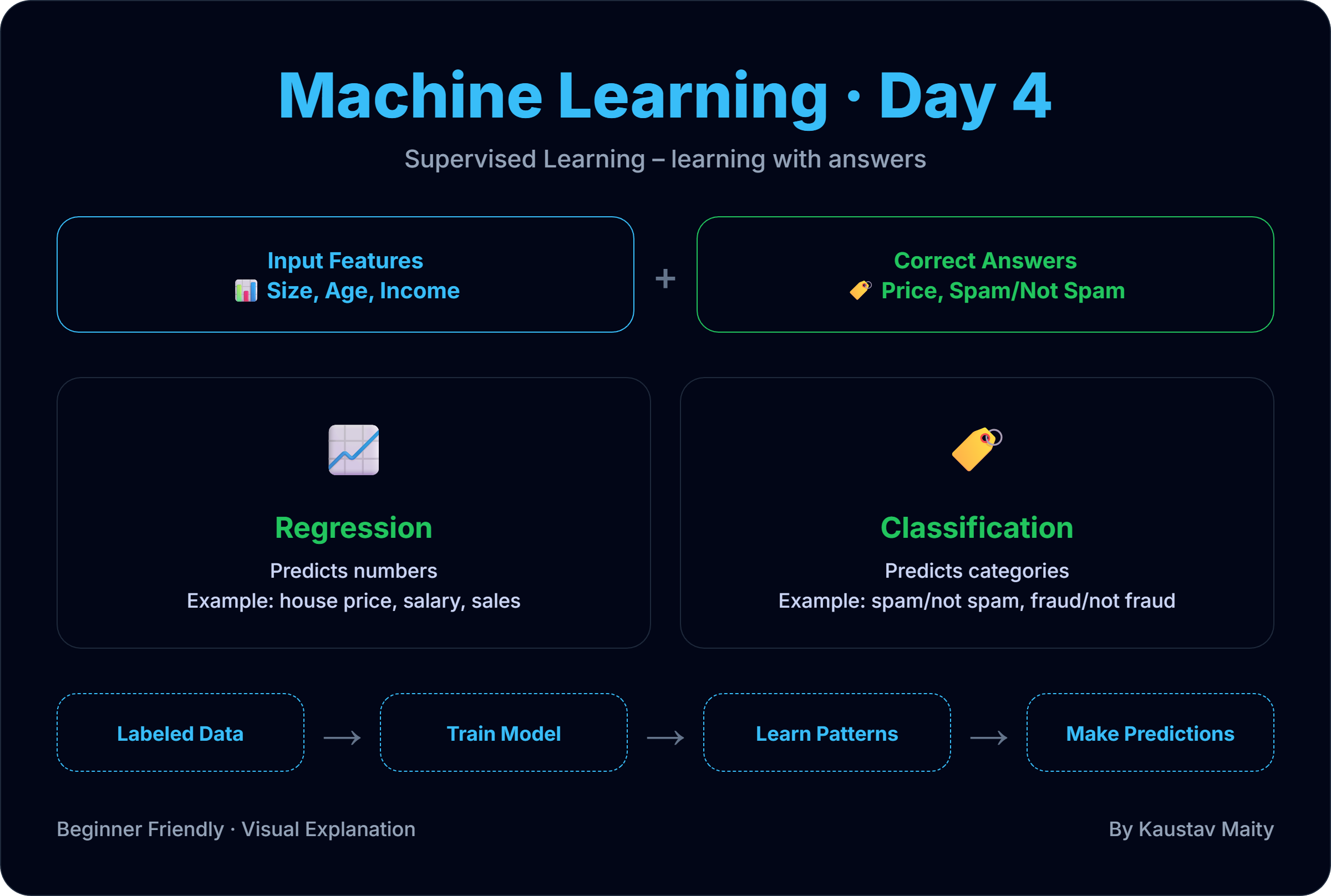
📘 Day 4: Supervised Learning – Learning with Answers
After understanding data and math intuition, it’s time to learn the first real type of machine learning you’ll actually use in projects.
That type is Supervised Learning.
This is the most common and practical form of machine learning used in industry today.
📌 What Is Supervised Learning?
Supervised Learning is a type of machine learning where:
- The data already has answers
- The model learns from input → output examples
- Then it predicts outputs for new, unseen data
In simple words:
We show the model questions with correct answers,
and it learns how to answer similar questions in the future.
🧠 Simple Intuition
Think of a student preparing for an exam 📚
- Teacher gives questions + correct answers
- Student practices
- Student learns patterns
- Student answers new questions in the exam
That’s exactly how supervised learning works.
📂 What Does Supervised Data Look Like?
Supervised learning data always has:
- Features (inputs)
- Label (output)
Example (House Prices):
| Size (sqft) | Location | Price (lakhs) |
|---|---|---|
| 800 | City | 40 |
| 1000 | City | 50 |
| 1200 | Suburb | 55 |
📌 Here, Price is the label.
🧩 Two Types of Supervised Learning
Supervised learning is divided into two major categories.
1️⃣ Regression – Predicting Numbers
Use Regression when the output is a number.
📌 Examples:
- House price prediction
- Salary prediction
- Sales forecasting
- Temperature prediction
Intuition
The model learns:
“When input changes, how does the number change?”
Example:
- Bigger house → higher price
- More experience → higher salary
2️⃣ Classification – Predicting Categories
Use Classification when the output is a category or label.
📌 Examples:
- Spam vs Not Spam
- Fraud vs Not Fraud
- Pass vs Fail
- Disease vs No Disease
Intuition
The model learns:
“Which group does this data point belong to?”
🔍 Regression vs Classification (Quick Comparison)
| Feature | Regression | Classification |
|---|---|---|
| Output | Number | Category |
| Example | Price = 45 | Spam / Not Spam |
| Goal | Predict value | Predict class |
| Common Models | Linear Regression | Logistic Regression |
🏗️ How Supervised Learning Works (Step-by-Step)
- Collect labeled data
- Split into training & test sets
- Train a model on training data
- Test the model on unseen data
- Measure performance
- Improve the model
📌 The model learns patterns from past examples.
💻 Simple Supervised Learning Example (Python)
Regression Example: Predicting House Price
from sklearn.linear_model import LinearRegression
import numpy as np

# Input features
X = np.array([[800], [1000], [1200], [1500]])
y = np.array([40, 50, 55, 70])

# Train model
model = LinearRegression()
model.fit(X, y)

# Predict
price = model.predict([[1100]])
print(f"Predicted price: {price[0]:.2f} lakhs")
📤 Output
Predicted price: 52.50 lakhs
📌 The model learned the relationship between size and price.
🌍 Real-World Uses of Supervised Learning
- 🏦 Banking – credit scoring, fraud detection
- 🛒 E-commerce – price prediction, demand forecasting
- 🏥 Healthcare – disease diagnosis
- 📧 Email – spam filtering
- 📈 Business – sales and revenue prediction
⚠️ Common Beginner Mistakes
❌ Training on very little data
❌ Data leakage between train & test
❌ Ignoring evaluation metrics
❌ Assuming high accuracy = good model
📌 Always test on unseen data.
📝 Final Thoughts
Supervised Learning is the foundation of machine learning.
If you understand:
- Regression
- Classification
- Labeled data
You already understand 70% of real-world ML use cases.
This day is about learning how machines learn from examples—
the same way humans do.
Comments (0)
No comments yet. Be the first to share your thoughts!
Leave a Comment