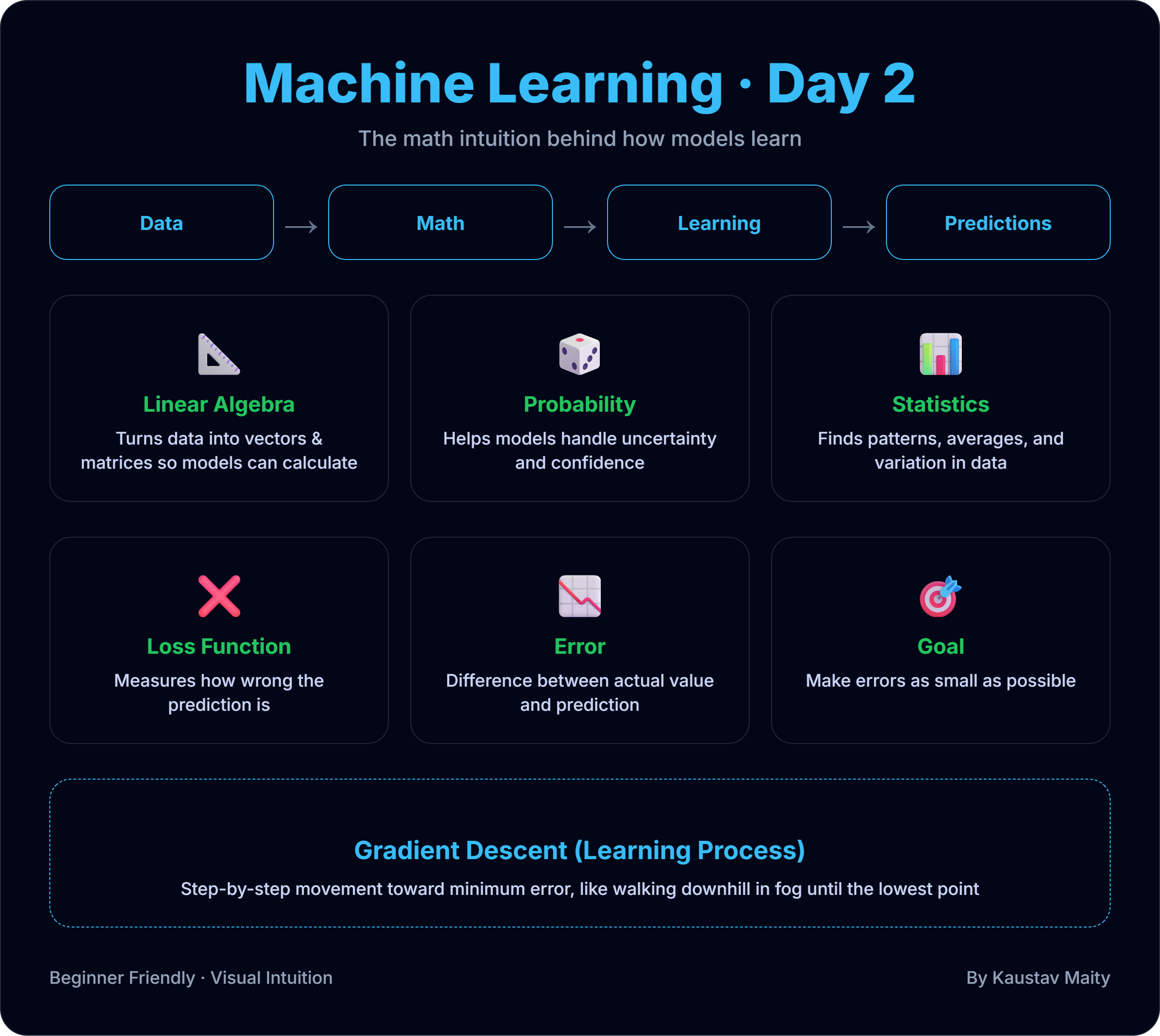
📐 Machine Learning Mathematics: The Intuition You Actually Need (Day 2)
Many people feel scared when they hear “Machine Learning Mathematics”.
But the truth is 👉 you don’t need to be a mathematician to understand ML.
You only need to understand what the math means, not memorize formulas.
This post explains the core math ideas behind machine learning in simple terms.
📌 Why Mathematics Is Important in Machine Learning
Machine learning models are not magic.
They are mathematical functions that:
- Take input data
- Perform calculations
- Produce predictions
Math helps us answer questions like:
- How does the model learn?
- How does it improve?
- How do we know if it’s wrong?
🧮 1. Linear Algebra (Data Representation)
Machine learning works with numbers, and linear algebra is how we organize them.
Simple intuition
- Single value → number
- Multiple values → vector
- Table of values → matrix
Example:
- One house → size = 900
- Many houses →
[500, 800, 1000, 1200]
📌 ML models treat datasets as matrices and perform calculations on them.
You don’t need to master matrix math now — just know:
Data in ML = vectors & matrices
🎲 2. Probability (Handling Uncertainty)
Machine learning deals with uncertainty, not guarantees.
Examples:
- Email is spam with 90% probability
- Customer may churn with 70% probability
Probability helps models answer:
- How confident is this prediction?
- How likely is an event?
📌 ML doesn’t say “YES or NO”
👉 It says “how likely”
📊 3. Statistics (Learning from Data)
Statistics helps models learn patterns from data.
Key ideas:
- Mean → average value
- Variance → how spread out data is
- Distribution → how data behaves
Example:
- Average house price in an area
- Price variation across locations
📌 Statistics helps us:
- Understand data
- Detect noise
- Measure model performance
📉 4. Loss Function (How Wrong Is the Model?)
A model learns by making mistakes.
A loss function measures:
“How wrong is the prediction?”
Example:
- Actual price = 50
- Predicted price = 45
- Error = 5
The goal of ML:
Minimize the loss
Smaller loss = better model.
🏃♂️ 5. Gradient Descent (How Models Learn)
This is the heart of machine learning learning.
Simple analogy
Imagine standing on a mountain in fog 🌫️
You want to reach the lowest point.
You:
- Take small steps
- Move downward
- Stop when you can’t go lower
That’s Gradient Descent.
📌 In ML:
- Mountain height = loss
- Direction = gradient
- Steps = learning rate
The model slowly improves by reducing errors step by step.
🧠 How All Math Fits Together
Here’s the full picture:
- Linear Algebra → handles data
- Probability → handles uncertainty
- Statistics → learns patterns
- Loss Function → measures mistakes
- Gradient Descent → fixes mistakes
Together, they allow a machine to learn from data.
⚠️ Common Beginner Mistake
❌ Trying to memorize formulas
✅ Understanding intuition
Most ML engineers:
- Use libraries (scikit-learn, TensorFlow)
- Focus on why things work
- Learn math gradually while building models
📝 Final Thoughts
You don’t need to master all math before machine learning.
Start with:
- Clear intuition
- Practical examples
- Real-world thinking
As you build models, the math will naturally make sense.
Machine learning math is not hard —
it’s just logic written with numbers.
Comments (0)
No comments yet. Be the first to share your thoughts!
Leave a Comment