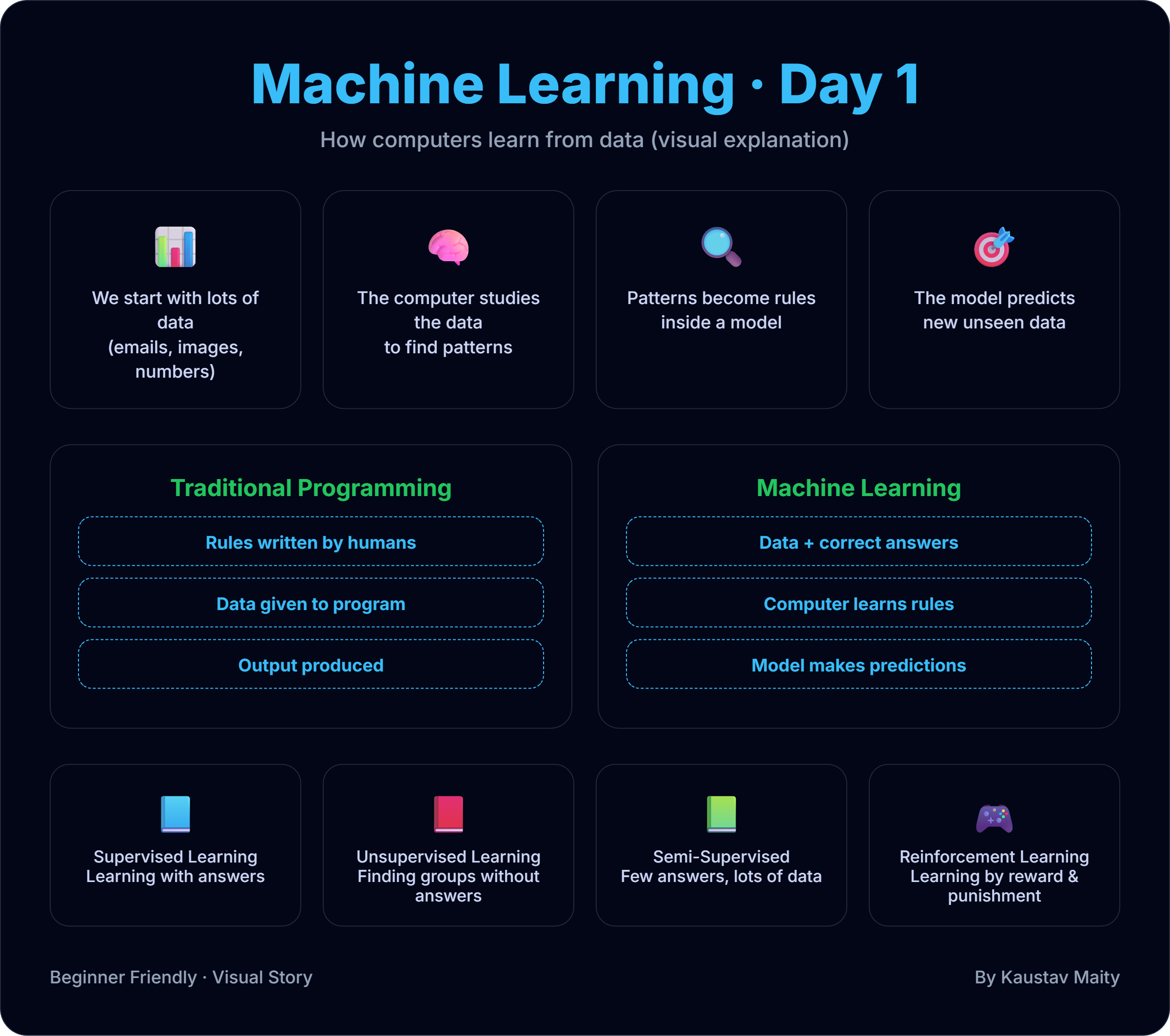
🤖 Machine Learning: Teaching Computers to Learn from Data
📌 What Is Machine Learning?
Machine Learning (ML) is a part of Artificial Intelligence that allows computers to learn from data and improve with experience, instead of following hard-coded rules.
In simple words:
Instead of telling a computer every rule, we show it examples, and it learns the rules by itself.
Just like humans learn from past experience, machines learn from past data.
🧠 How Machine Learning Actually Works
Machine learning always follows a simple idea:
Data → Learning → Pattern → Prediction
A typical ML workflow looks like this:
-
Collect data 📊
Example: house size, location, price -
Clean & prepare data 🧹
Remove errors, missing values, noise -
Train a model 🏋️
The model learns the relationship inside the data -
Evaluate the model 📈
Check how accurate the predictions are -
Make predictions 🔮
Use the model on new, unseen data
Simple intuition
If the model sees many houses and prices, it slowly understands:
👉 “Bigger houses usually cost more.”
🧩 Types of Machine Learning
1️⃣ Supervised Learning
- Data has labels (answers)
- Model learns input → output mapping
📌 Examples:
- Spam vs non-spam emails
- House price prediction
- Credit score prediction
💡 Think of it as learning with a teacher.
2️⃣ Unsupervised Learning
- Data has no labels
- Model finds hidden patterns by itself
📌 Examples:
- Customer segmentation
- Grouping similar products
- Anomaly detection
💡 Think of it as discovering patterns without guidance.
3️⃣ Reinforcement Learning
- Model learns by trial and error
- Uses rewards and penalties
📌 Examples:
- Game-playing AI (Chess, Go)
- Robotics
- Self-driving cars
💡 Similar to how humans learn by trying, failing, and improving.
💻 A Very Simple Machine Learning Example (Python)
Below is a basic example using Linear Regression to predict house prices:
from sklearn.linear_model import LinearRegression
import numpy as np

# Training data
house_size = np.array([[500], [800], [1000], [1200]])
house_price = np.array([25, 40, 50, 60])  # in lakhs

# Train model
model = LinearRegression()
model.fit(house_size, house_price)

# Predict price for new house
prediction = model.predict([[900]])
print(f"Predicted price: {prediction[0]:.2f} lakhs")
📤 Output
Predicted price: 45.00 lakhs
📌 The model learned the relationship between house size and price from data.
🌍 Where Machine Learning Is Used in Real Life
You interact with ML every day:
- 🛒 E-commerce – product recommendations
- 🏦 Finance – fraud detection, credit scoring
- 🏥 Healthcare – disease prediction
- 📱 Social Media – feed ranking, face recognition
- 🚗 Transportation – navigation & self-driving systems
⚠️ Challenges in Machine Learning
Machine learning is powerful, but not perfect:
- Poor data quality ❌
- Biased data ⚖️
- High computation cost 💰
- Hard-to-explain models 🤔
📌 In real projects, good data matters more than complex algorithms.
📝 Final Thoughts
Machine Learning is not magic ✨.
It is a combination of:
- Data
- Mathematics
- Algorithms
- Computing power
When used correctly, ML helps solve problems that are too complex for traditional programming.
This Day 1 foundation is all about understanding the idea, not memorizing algorithms.
Comments (0)
No comments yet. Be the first to share your thoughts!
Leave a Comment