📌 Sessionization in SQL (User Sessions from Event Data)
Sessionization is one of the most practical and high-impact SQL problems used in analytics, data engineering, and product tracking.
If you work with user events, clickstreams, logs, or app activity, this concept is unavoidable.
🧠 What is Sessionization?
Sessionization means grouping a user’s events into logical sessions based on inactivity time gaps.
📌 A session typically:
- Starts when a user becomes active
- Ends after a fixed period of inactivity (e.g., 30 minutes)
🎯 Problem Statement
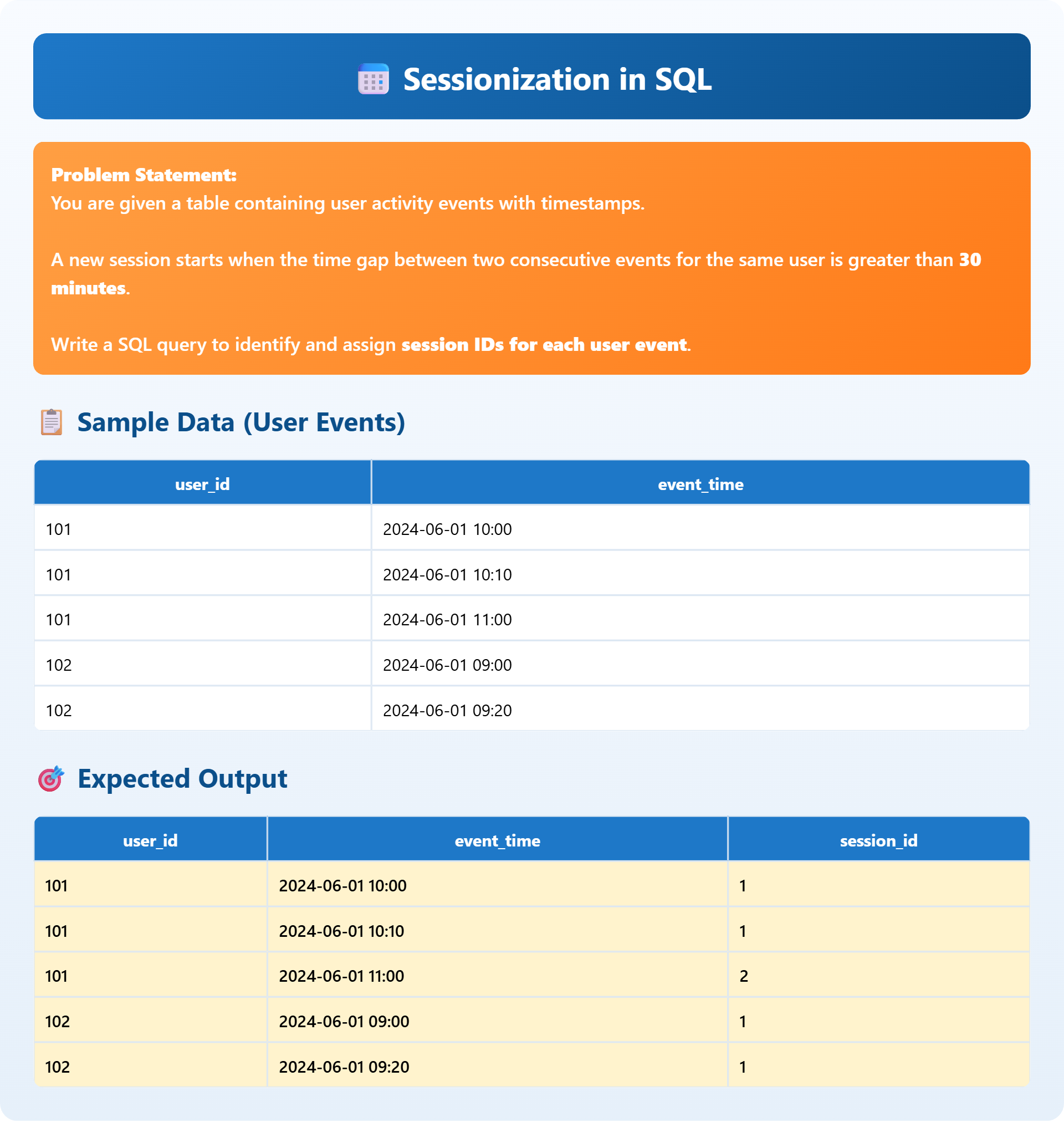
You are given a table of user events with timestamps.
👉 Your task is to identify user sessions, where a new session starts if the time gap between two consecutive events is greater than 30 minutes.
🧾 Real-World Use Cases
Sessionization is used in:
- Website & app analytics (Google Analytics style sessions)
- User journey analysis
- Funnel & conversion tracking
- Behavioral analytics
- Clickstream processing
- Fraud & anomaly detection
📋 Sample Table Structure
Assume a table like this:
user_idevent_time(timestamp)
Each row represents one user action.
🧠 Key Idea Behind Sessionization
To build sessions, we need to:
- Order events per user
- Compare each event with the previous one
- Detect inactivity gaps
- Start a new session when the gap exceeds the threshold
- Assign a session ID
✅ Recommended SQL Approach
Sessionization is best solved using window functions:
LAG()→ to look at the previous event- Conditional logic → to detect session breaks
- Running
SUM()→ to generate session IDs
This approach is:
✔ Scalable
✔ Readable
✔ Industry-standard
✔ Interview-friendly
🔍 Conceptual Logic (No Code Yet)
For each user:
- Calculate time difference between current and previous event
- If gap > 30 minutes → new session
- Otherwise → same session
- Cumulatively sum session breaks to assign session numbers
📌 Key Insight
Sessionization = Detect breaks + Cumulative grouping
Once you identify where a session breaks, everything else becomes grouping.
⚠️ Common Mistakes
❌ Using self-joins (slow & complex)
❌ Ignoring event ordering
❌ Not handling first event correctly
❌ Hard-coding session IDs
🎯 Interview Tip
Always clarify:
- What is the session timeout? (15, 30, 60 minutes?)
- Are sessions user-specific?
- Should overlapping events be merged?
- What defines inactivity?
Your assumptions matter as much as your SQL.
💬 Practice Questions
- How would you calculate session duration?
- How do you count events per session?
- How would you handle out-of-order events?
- How would this work on streaming data?
📈 Why Sessionization Matters
If you can solve this problem confidently, you demonstrate:
- Strong SQL fundamentals
- Real-world analytics thinking
- Data engineering maturity
Comments (0)
No comments yet. Be the first to share your thoughts!
Leave a Comment