SELF JOIN in SQL (Beginner-Friendly Explanation)
A SELF JOIN sounds scary at first, but the idea is actually very simple.
Let’s understand it slowly, using a real-life example and plain language.
What is a SELF JOIN?
👉 SELF JOIN = joining a table with itself
Why would we do that?
Because one row in a table is related to another row in the same table.
Real-Life Example: Employee & Manager
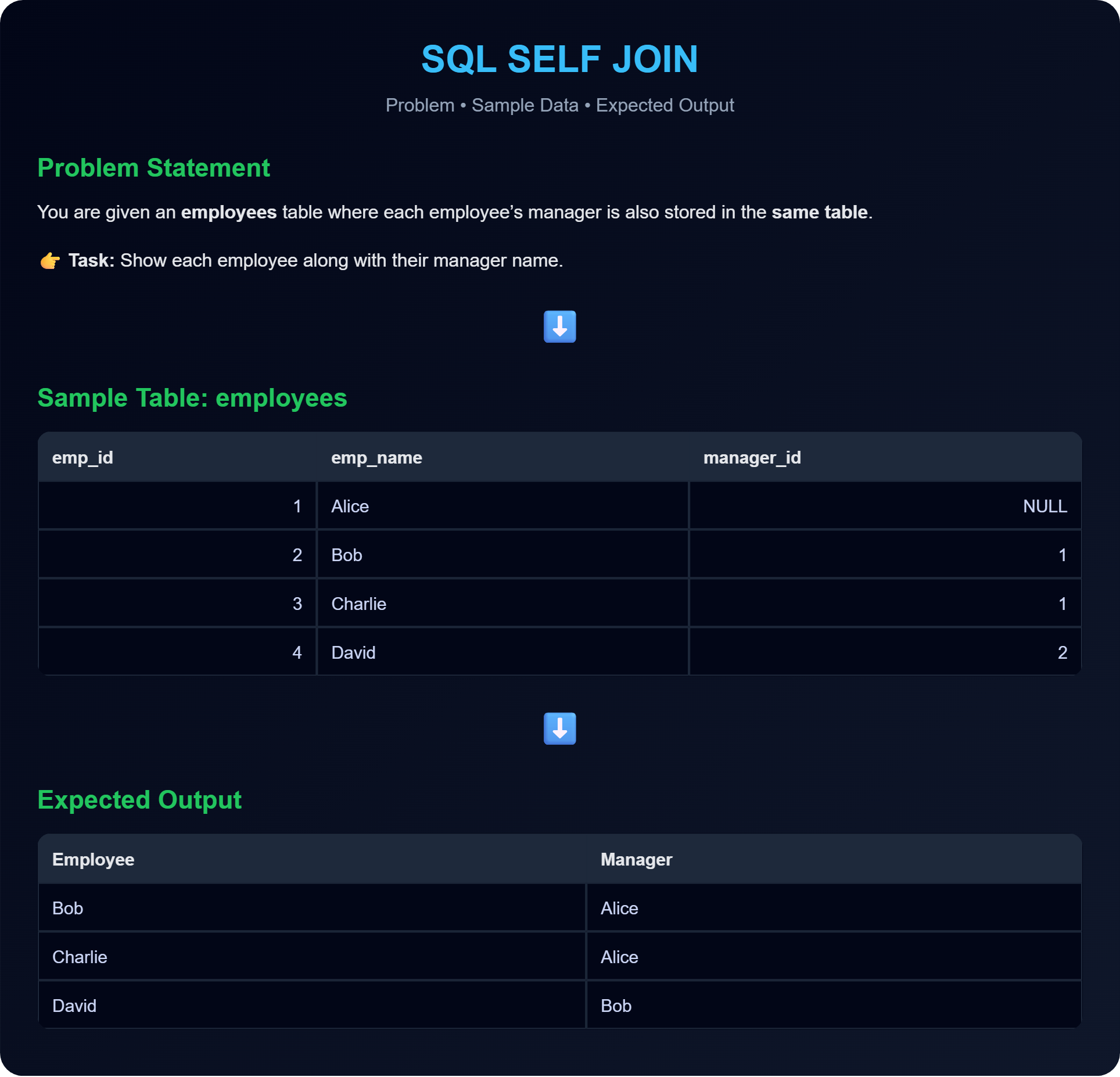
Imagine an employees table.
| emp_id | emp_name | manager_id |
|---|---|---|
| 1 | Alice | NULL |
| 2 | Bob | 1 |
| 3 | Charlie | 1 |
| 4 | David | 2 |
How to read this:
- Alice has no manager (CEO)
- Bob reports to Alice
- Charlie reports to Alice
- David reports to Bob
👉 Employee and Manager are in the SAME table
The Problem
👉 Show employee name and manager name
Expected output:
| Employee | Manager |
|---|---|
| Bob | Alice |
| Charlie | Alice |
| David | Bob |
Why Normal JOIN Won’t Work
There is only one table.
So we use the same table twice, with different names.
These names are called aliases.
The SELF JOIN Query
SELECT
  e.emp_name   AS employee,
  m.emp_name   AS manager
FROM employees e
JOIN employees m
  ON e.manager_id = m.emp_id;
Step-by-Step (Very Important)
Step 1: Table Aliases
employees e   -- employee
employees m   -- manager
Same table, two roles.
Step 2: Join Condition
e.manager_id = m.emp_id
Meaning:
“Employee’s manager_id matches manager’s emp_id”
Step 3: Result
- Bob → manager_id = 1 → Alice
- David → manager_id = 2 → Bob
✔ Relationship found inside the same table
Visual Way to Think 🧠
Think of the table as:
- One copy → employees
- Second copy → managers
But both are the same table
Another Simple Example: Compare Rows
Example Table
| id | value |
|---|---|
| 1 | 10 |
| 2 | 20 |
| 3 | 30 |
👉 Find pairs where one value is greater than another
SELECT a.id, b.id
FROM numbers a
JOIN numbers b
ON a.value > b.value;
✔ Table compared with itself
When Do You Use SELF JOIN?
Use SELF JOIN when:
- Employee–manager hierarchy
- Parent–child relationships
- Comparing rows in the same table
- Finding duplicates
- Finding previous / next records (alternative to window functions)
Beginner Rule to Remember 🧠
If a row needs information from another row in the same table,
you need a SELF JOIN.
One-Line Summary
SELF JOIN means using one table twice to compare or relate its own rows.
Comments (0)
No comments yet. Be the first to share your thoughts!
Leave a Comment